
Bearing grease rarely appears on an energy-efficiency roadmap or a sustainability report.
It should. As EU energy regulation tightens and emissions reporting becomes mandatory rather than voluntary, condition-based lubrication (the kind of measured, documented practice enabled by tools the LUBEChecker, the SDT340 LUBExpert Mode, and the LUBExpert ON-GUARD) turns out to be a surprisingly strong lever on both fronts.
Friction is an electricity bill, not just a wear mechanism
A landmark peer-reviewed study by Kenneth Holmberg[1] and Ali Erdemir[2], published in the journal Friction in 2017, calculated that approximately 23% (119 exajoules) of all global energy consumption originates from tribological contacts (friction and wear) across transportation, manufacturing, power generation, and residential sectors. Of that, roughly 20% (103 EJ) is consumed directly overcoming friction, and 3% (16 EJ) is spent remanufacturing worn parts and equipment lost to wear-related failure[3]. The same study estimates that better lubrication and friction-reduction technology could plausibly cut these losses by 18% within eight years and by 40% within fifteen years, savings equal to roughly 1.4% of global GDP annually and 8.7% of total global energy consumption.
Bearings sit right in the middle of that friction budget, because they are the mechanical interface inside almost every motor-driven system in a plant. And motor-driven systems are not a marginal energy user. The International Energy Agency identifies them as the single largest electricity end-use worldwide, responsible for more than 40% of global electricity consumption, rising to roughly 69–72% of industrial electricity consumption specifically[4] . The IEA further estimates that around 20–30% of motor-driven system electricity use could be saved cost-effectively with existing technologies and practices.
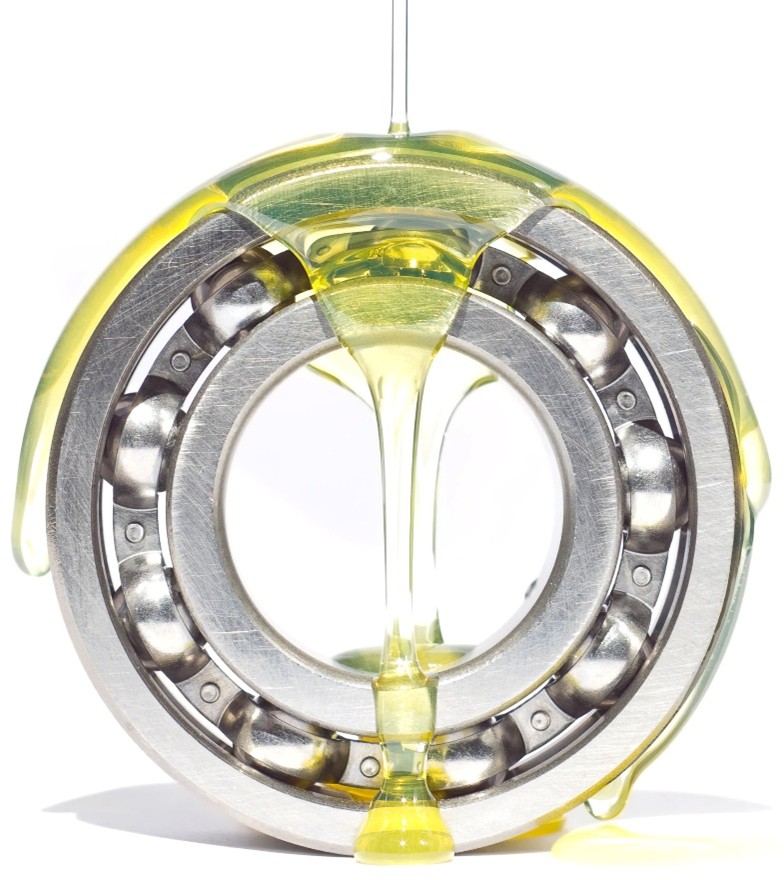
A poorly lubricated bearing (whether under- or over-greased) increases friction at the rolling-element contact zone, which increases the torque the motor must supply to maintain speed, which increases current draw and dissipated heat. This is exactly the effect the LUBEChecker targets at the source: Properly lubricated bearings draw less power and run cooler, lowering energy use and emissions… Less waste, lower energy use, and longer-lasting equipment all contribute to a more efficient, responsible operation. Multiply that small per-bearing effect across every motor, pump, fan and conveyor drive in a plant, and the aggregate energy impact becomes directly relevant to a facility’s electricity bill, and its regulatory reporting obligations.
EU regulation now demands exactly this kind of evidence
European industrial companies are no longer just encouraged to pursue energy efficiency. For many, it’s now a binding legal obligation with real deadlines.
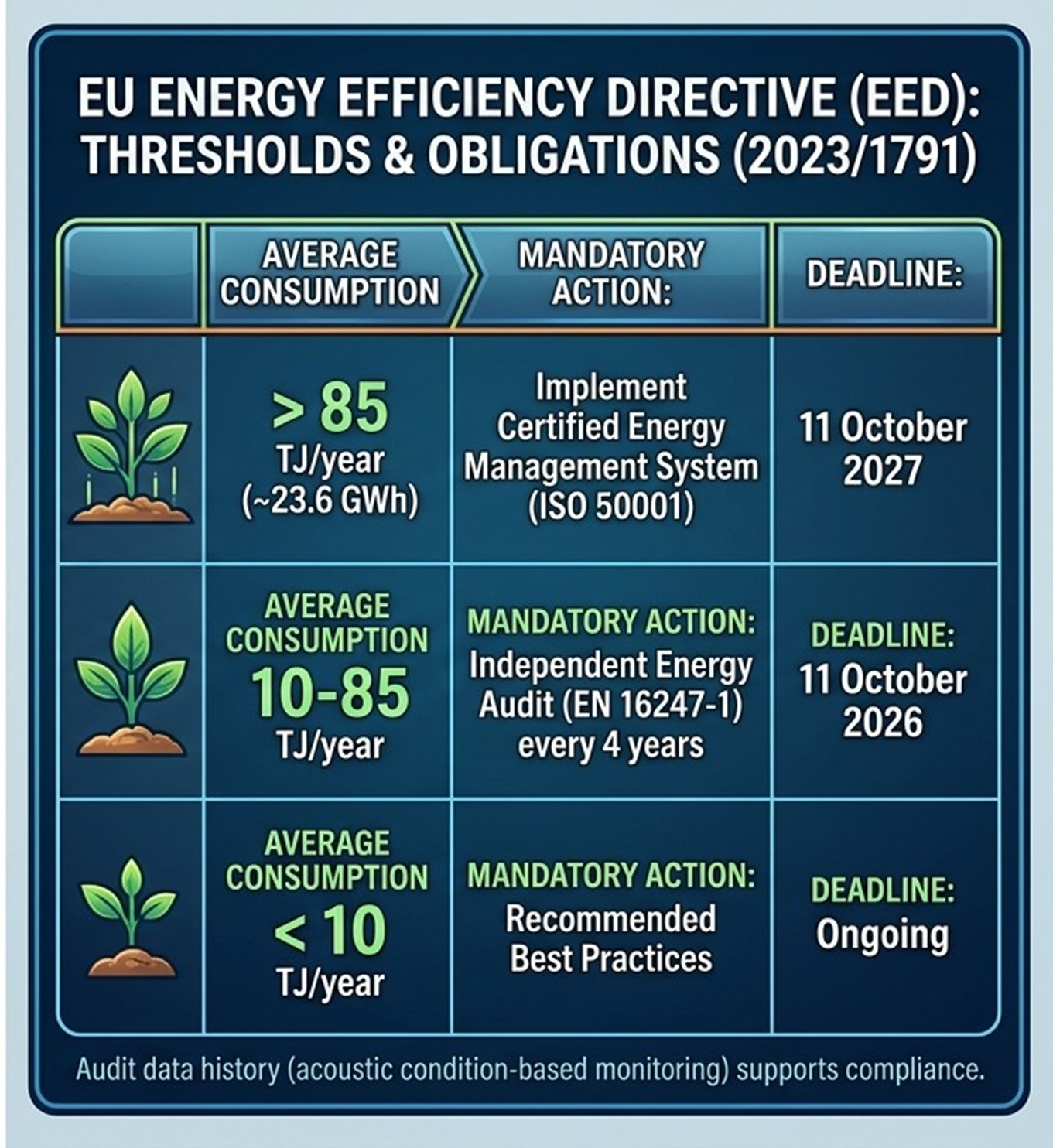
Directive (EU) 2023/1791 — the recast Energy Efficiency Directive enshrines “Energy Efficiency First” as a governing principle of EU energy policy and sets a legally binding target to cut EU final energy consumption by 11.7% by 2030, relative to a 2020 baseline projection. It raises the EU’s annual energy-savings obligation on Member States from a historical 0.8% to 1.3% for 2024–2025, 1.5% for 2026–2027, and 1.9% from 2028 onward[5]. Under Article 11, obligations on individual companies are tied to energy-consumption thresholds:
- Organizations averaging more than 85 TJ/year (≈23.6 GWh) of energy consumption over the preceding three years must implement a certified Energy Management System (typically ISO 50001) by 11 October 2027[6].
- Organizations averaging 10–85 TJ/year must undergo an independent energy audit at least every four years, with the first audit due by 11 October 2026, unless they voluntarily implement a certified EMS instead[7].
- Audits and management systems must be benchmarked against recognized standards explicitly named in the directive, including EN ISO 50001 (energy management systems) and EN 16247-1 (energy audits)[8].
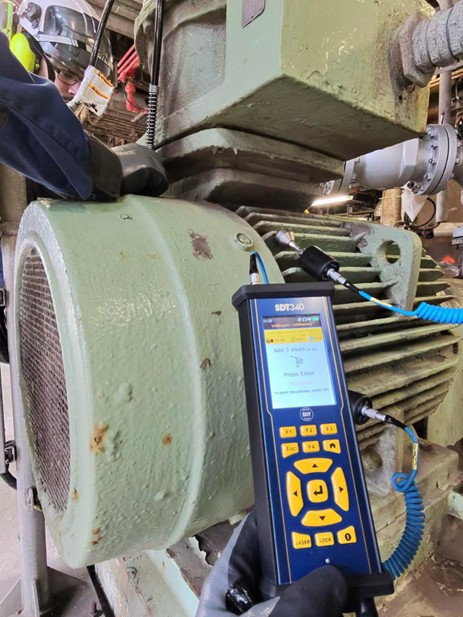
This is not a distant, abstract compliance exercise. For any manufacturing site above the 10 TJ threshold (a modest bar for most mid-sized and large industrial facilities) auditors will look for documented Energy Performance Indicators (EnPIs) and evidence of continuous improvement in the plant’s largest energy-consuming systems. Given that motor-driven equipment typically represents 60–70% or more of a plant’s electricity use, bearing friction management is a natural, defensible EnPI category. A fully logged, condition-based lubrication history (exactly what the SDT340 LUBExpert Mode generates automatically as a byproduct of normal use) is precisely the kind of auditable data trail an ISO 50001 or EN 16247-1 assessment rewards. A plant that can show, bearing by bearing, that grease is applied only when acoustic data indicates it is needed (not on an arbitrary calendar), is demonstrating “Energy Efficiency First” in the most literal, granular sense the directive intends.
Wider sustainability reporting context. The EU’s broader sustainability architecture, including the Corporate Sustainability Reporting Directive (CSRD) and the European Green Deal’s target of climate neutrality by 2050 alongside a 55% cut in CO₂ emissions by 2030, increasingly requires companies to report Scope 1 and Scope 2 emissions (and, for many, Scope 3) with credible supporting data. Reduced electricity draw from friction-optimized rotating equipment contributes directly to Scope 2 emissions reduction, and a documented lubrication program adds a concrete, verifiable data point to what can otherwise be a difficult reporting category to substantiate.
Sustainability isn’t only about kilowatt-hours. It’s about waste avoided
The Holmberg and Erdemir research also puts a number on the material waste of poor friction management: of the 23% of global energy tied to tribological contacts, a full 3% (16 EJ) is spent not on operating machinery, but on remanufacturing worn parts and spare equipment after wear-related failure[9]. Every bearing that fails prematurely because of bad lubrication has to be replaced, consuming new steel, new manufacturing energy, new transport emissions, and generating scrap. Every liter of grease over-applied and purged out of a bearing housing is lubricant waste that eventually needs collection and disposal.
Precision lubrication directly reduces both. With the SDT340 LUBExpert Mode, users get real-time feedback as you grease, protecting seals and saving grease… Less waste, lower energy use, and longer-lasting equipment all contribute to a more efficient, responsible operation. At the automated end of the portfolio, the LUBExpert ON-GUARD makes the same point at industrial scale: condition-triggered grease injection reduces workload and grease waste compared with fixed-interval automatic lubricators that dispense grease on a timer regardless of actual need. Extending bearing service life is, in itself, one of the most effective sustainability levers available in rotating equipment. It defers the embodied-carbon cost of manufacturing a replacement part indefinitely, simply by getting the maintenance right the first time.
The bottom line
Precision lubrication touches sustainability from three angles at once: less wasted electricity from friction, less scrapped material from premature bearing failure, and — increasingly important under EU law — auditable data that satisfies binding energy-management obligations rather than vague good intentions. Few maintenance practices this small generate compliance-grade evidence this naturally.
[1] VTT Technical Research Centre of Finland[2] Argonne National Laboratory / Texas A&M University[3] Holmberg & Erdemir, Friction, 5(3), 263–284, 2017[4] IEA, “Energy-Efficiency Policy Opportunities for Electric Motor-Driven Systems,” 2011; IEA-4E EMSA Policy Brief, 2026[5] PACI Global, summary of Directive (EU) 2023/1791, 2023[6] Accevo, “ISO 50001 and EU Directive 2023/1791,” 2026[7] Certiget, 2025; EM3 Energy, 2026[8] PACI Global, 2023[9] Holmberg & Erdemir, 2017