Industry: Hydropower & Renewable Energy
Application: Hydraulic Turbines (Francis & Pelton)
Location: Tumpen-Habichen Hydropower Plant, Tyrol, Austria
Solution: SDT Ultrasound’s CONMONSense AE Sensors, powering Global Hydro‘s SediSense (sediment) and CaviDect (cavitation) software solutions within the Hydrox IoT Platform
Executive Summary
Sediment erosion and cavitation are two of the most destructive forces facing hydroelectric power plants worldwide. Until recently, plant operators relied on upstream turbidity sensors or static operating restrictions, lacking direct, real-time visibility into actual physical damage occurring inside the turbine.
By combining SDT’s high-precision structure-borne Acoustic Emission (AE) sensing technology with Global Hydro’s Hydrox IoT edge-and-cloud architecture, Global Hydro successfully demonstrated a unified, real-time monitoring solution. Implemented on three Francis turbines at the 15 MW Tumpen-Habichen plant in Austria, this joint innovation isolated sediment impact energy, identified cavitation inception thresholds, and uncovered that active cavitation was forcing Turbine T3 to run with 6% more guide vane opening than needed to hit the same power output – a temporary hydraulic efficiency penalty tied to cavitation itself, separate from and previously masked by the plant’s ongoing sediment-erosion wear.
Equipped with these real-time insights, operators shifted from reactive maintenance to predictive asset protection, derating capacity dynamically to eliminate active cavitation while maintaining
The Challenge: A Dual Threat to Turbine Assets
Hydroelectric plants operating in alpine and glacier-fed catchments face severe operational stress from sediment-laden water. Hard quartz and fine sand bypass upstream desanding systems, causing hydro-abrasive wear on runners, guide vanes, and draft tubes.
Compounding this problem is cavitation, the implosion of vapor bubbles causing micro-jets and surface pitting. Sediment particles lower the pressure threshold for cavitation, while cavitation-roughened surfaces accelerate abrasive erosion.
Operators at the demonstration site faced three primary hurdles:
- Unreliable proxies
Upstream turbidity sensors measure light scattering in water, not the true kinetic impact or damaging potential of coarse sediment reaching the turbine. - Hidden efficiency losses
Without real-time internal monitoring, operators attributed all component wear solely to sediment, unaware that active cavitation was also present, both quietly eroding hydraulic surfaces over time and, in the moment, costing hydraulic efficiency whenever the turbine ran in a cavitating operating range. - Conservative vs. risky operation
Traditional cavitation prevention relies on static, worst-case operational boundaries that either sacrifice clean-water energy production or fail during unexpected flow shifts.
The Solution: Enabling Sensing Technology Meets Advanced IoT
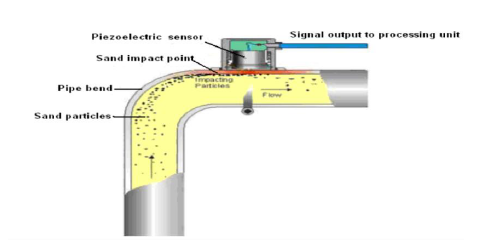
To overcome these boundaries, Global Hydro integrated SDT’s CONMONSense AE sensors as the sensing foundation for SediSense, its AI-powered sediment monitoring solution, deployed directly onto the outer hydraulic surfaces of the turbines (spiral case, guide vanes, and draft tube cone). The same sensors detect both sediment erosion and cavitation; depending on the customer’s requirements, SediSense (sediment monitoring) and CaviDect (cavitation monitoring) can be activated.
Key Technical Capabilities:
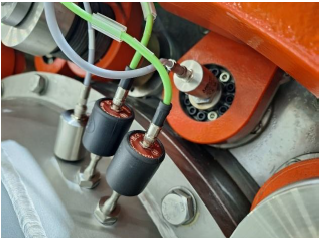
- High-frequency ultrasonic sensing (20–100 kHz): SDT piezoelectric sensors capture high-frequency energy generated by particle impacts and micro-implosions, filtering out low-frequency (<20 kHz) background machinery noise.
- On-sensor heterodyning: SDT’s internal heterodyning down-converts ultrasonic signals to the audible spectrum. This allows standard Beckhoff PLC hardware to sample data efficiently without requiring ultra-high-bandwidth, expensive acquisition systems.
- Statistical signal decomposition: An Expectation-Maximization (EM) mixture model separates the signal into two distinct indicators:
- Rayleigh noise component: Measures continuous particle impact background noise (Sediment Erosion Indicator).
- Weibull impulsive component: Captures sharp, high-energy transient spikes (Cavitation Indicator).
- Machine-learning baseline compensation: A gradient-boosting ML model (trained in Global Hydro’s cloud platform) predicts operational hydraulic noise based on telemetry (power, head level, pressure, gate opening). Subtracting this baseline isolates pure sediment activity in real time.
Results & Operational Impact
Field validation across three Francis turbines delivered compelling operational breakthroughs:
1. Uncovering Hidden Cavitation & Its Real-Time Efficiency Cost
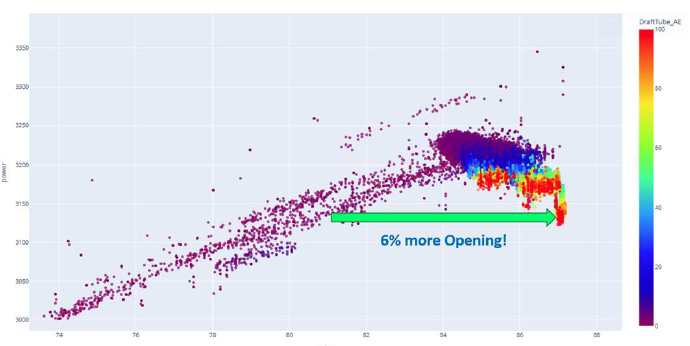
On Turbine T3, acoustic monitoring revealed sharp impulse bursts when the guide vane opening exceeded 85%. When operating within this cavitation regime, the turbine required 6% more guide vane opening to achieve the exact same power output compared to non-cavitation conditions. The AE system pinpointed both the precise onset threshold and the immediate hydraulic efficiency penalty of active cavitation – a real-time operating effect distinct from, and measurable well before, any longer-term efficiency decline that sediment or cavitation erosion might eventually cause through accumulated wear.
2. Predictive Power Derating & Risk Elimination
With real-time visibility provided by SDT sensors, operators dynamically capped Turbine T3’s maximum guide vane opening, reducing peak output from 3,200 kW to 3,000 kW. Over months of continuous post-intervention monitoring, cavitation-impulse bursts disappeared and the Weibull impulsive power component collapsed, while the Rayleigh background (sediment) signal remained stable, confirming the derating eliminated cavitation activity without affecting the ongoing sediment signal. Total plant production remained unaffected as neighboring turbines compensated for the load. The benefit is twofold: operators recovered the hydraulic efficiency lost to active cavitation immediately, while removing the cavitation activity that would otherwise have contributed to long-term erosion of the turbine’s hydraulic surfaces.
3. True Localized Erosion Visibility
During headpond flushing events, AE noise power dropped immediately as sediment was diverted away from the turbine intake. In contrast, conventional intake turbidity sensors remained artificially elevated. SDT’s structure-borne sensing proved that it measures actual particle damage reaching the runner rather than general upstream water quality. This is the core capability SediSense delivers: measuring actual sediment impact at the turbine, not a water-quality proxy upstream.
Key Benefits Summary
| Challenge | Traditional Approach | Global Hydro × SDT’s CONMONSense Solution |
|---|---|---|
| Sediment Monitoring (SediSense) | Upstream turbidity sensors (light scattering proxy). | Direct impact energy quantification on internal hydraulic components. |
| Cavitation Detection (CaviDect) | Static operating limits based on conservative assumptions. | Real-time threshold identification via high-frequency transient analysis. |
| Data Efficiency | High bandwidth & costly specialized acquisition hardware. | Integrated heterodyning enabling standard PLC hardware acquisition. |
| Asset Strategy | Reactive maintenance after major wear occurs. | Predictive asset protection and dynamic condition-responsive control. |
Together, these results show the technology delivers value on two timescales: immediate performance optimization, by detecting and avoiding cavitating operating conditions that reduce hydraulic efficiency and increase the guide vane opening required for a given power output, and long-term asset protection, by mitigating sediment- and cavitation-erosion that gradually wears down turbine components. Operators no longer have to wait for measurable wear reduction to see a return, as the efficiency gains from avoiding cavitation are visible from day one.
This field-proven application highlights the strong synergy between SDT’s CONMONSense as a premium sensing provider and Global Hydro as an innovative OEM and digital solutions provider. Together, they offer hydro operators a scalable tool to extend turbine service life, optimize efficiency, and safeguard critical green energy infrastructure worldwide.