
In 2026, energy transition is no longer just a footnote in a CSR report for global industry.
Between the stringent requirements of the European CSRD and soaring electricity prices, efficiency has become a prerequisite for survival. Yet, massive amounts of energy continue to vanish, ignored simply because they are invisible and inaudible. Among these silent profit-killers: leaks and mechanical inefficiencies. At SDT Ultrasound, we believe the fight for our planet doesn’t start with massive capital expenditures, but with a keen ear tuned to the physical reality of the factory floor.

The Ethical Imperative of Energy Mastery
Why should we rethink our approach to compressed air and mechanical friction? The data is staggering. In a typical plant, compressed air accounts for 15% to 40% of the total electricity bill. Yet, audits reveal a harsh reality: on average, 30% to 50% of produced air is lost to leaks before it ever reaches its point of use.
Scientifically speaking, every leak is the direct conversion of electricity into turbulent noise. A single 3 mm orifice on a 7-bar network can bleed over 2 500 € per year and emit several tons of unnecessary CO2. But the waste isn’t confined to the piping. It hides deep within the machinery: poor lubrication increases friction, forcing motors to work harder and draw more power to maintain pace. With 80% of bearing failures linked to improper lubrication, the result is a massive cycle of energy overconsumption and wasted spare parts.
Turning Acoustic Data into Strategic Action
To bridge the gap between awareness and action, we must look to physics. Friction and turbulence generate high-frequency acoustic waves between 20 kHz and 100 kHz, well beyond the range of human hearing.
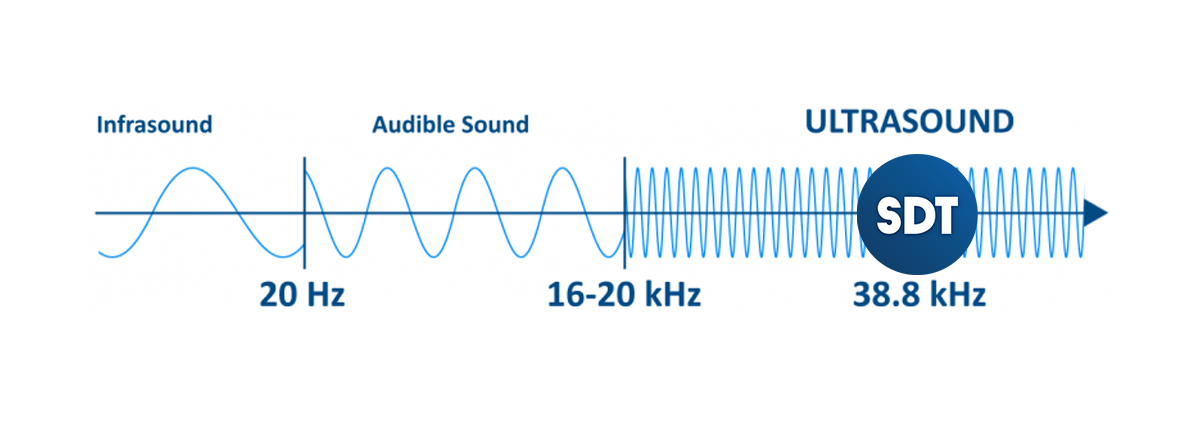
Ultrasound technology acts as a translator for these signals. It captures these waves, isolates them from the low-frequency roar of the plant, and converts them into audible, measurable data. But detection is only the first step. To make a real impact on the planet, you must quantify the loss. The SDT process is built on a high-value loop:
- Signal isolation: Pinpointing leaks or mechanical faults even in the loudest environments.
- Metric conversion: Using advanced algorithms to estimate the financial cost and carbon footprint of every leak or friction point.
- Data-driven leadership: Centralizing this intelligence to provide leadership teams with an immediate, verifiable ecological ROI.
This methodology allows maintenance teams to move past “firefighting” and into the proactive management of energy as a critical resource.
Democratizing Vigilance through Technology
To make this vision a reality, monitoring cannot remain the job of a few specialists; it must become everyone’s business. Democratizing these tools is the key to achieving sustainability at scale.
This is where targeted solutions like the LEAKChecker come in, empowering floor operators to conduct regular inspections without specialized training. Energy mastery also applies to movement: the LUBExpert solution turns bearing lubrication into a precision science. By delivering the exact amount of lubricant at the right moment, we drastically reduce mechanical resistance and the resulting electrical draw of the motors.
Finally, for rapid, large-scale visualization, the CRYSOUND acoustic camera allows teams to literally “see” ultrasound on a screen. It makes energy waste undeniable and immediate, scanning an entire workshop in minutes to identify the most critical losses.
Conclusion: Silence as a Strategic Asset
Decarbonizing industry doesn’t mean replacing every machine. It’s rather about the smarter management of the assets we already own. By making ultrasound a pillar of their energy strategy, industrial leaders do more than save money. They give new purpose to their operations and ensure the long-term viability of our environment.
Protecting the planet means deciding that no turbulence and no unnecessary friction should go unnoticed. The future of production will be silent, efficient, and sustainable. The question is no longer what an ultrasound system costs, but how much the losses you haven’t detected yet are costing you every single day.