For pharmaceutical manufacturers, cleanrooms and ATEX-rated hazardous zones present some of the most challenging operating environments in modern industry.
To maintain strict ISO cleanliness classifications and prevent cross-contamination, access to these controlled zones is heavily restricted.
Furthermore, the physical assets running inside these environments (such as cleanroom HVAC fans, exhaust blowers, and chemical formulation pumps) must operate continuously to maintain critical pressure cascades.
Any mechanical failure in these systems can lead to an immediate production halt and a highly costly decontamination process.
To address these challenges, facilities are utilizing advanced remote ultrasound diagnostics and precision, condition-based lubrication to protect critical bearings without disrupting cleanroom integrity.

The Critical Role of Cleanroom HVAC Systems
In a pharmaceutical cleanroom, the HVAC system acts as the facility’s lungs. It is designed to control multiple environmental parameters simultaneously:
- Maintaining sterile ISO 5 to ISO 8 cleanliness classifications.
- Controlling temperature and relative humidity within strict tolerances.
- Sustaining critical pressure cascades (typically 10 to 15 Pa differentials) between clean zones to prevent the migration of airborne contaminants.
If a supply blower or exhaust fan bearing fails, these pressure cascades collapse, sterile validation is lost, and the entire cleanroom must shut down immediately.
Despite their criticality, research indicates that up to 80% of premature bearing failures are caused by improper lubrication. Traditional, calendar-based schedules often result in under-lubrication (causing wear) or over-lubrication (which can rupture bearing seals and introduce grease contaminants directly into the cleanroom).

Precision Lubrication with the SDT LUBExpert
The SDT340 LUBExpert Mode transforms bearing lubrication from subjective guesswork into a data-driven, acoustic-guided process. Equipped with a resonant piezoelectric sensor (LUBESense1), the SDT340 measures high-frequency friction emissions directly from the bearing housing in real time.
The onboard assistant guides the technician through the greasing process step-by-step. As grease is added, the device continuously calculates friction levels and alerts the technician exactly when the lubricant film has reached its optimal thickness, signaling them to stop.
This precision approach prevents both over- and under-lubrication, extends bearing life, and eliminates the risk of grease contamination within cleanroom environments.
Safe Remote Inspection with Acoustic Imaging
While contact sensors are ideal for bearing maintenance, searching for pressurized gas leaks or electrical anomalies in hard-to-reach, hazardous, or ATEX-rated areas requires a different approach. Setting up ladders or wearing heavy protective suits to inspect elevated piping or electrical switchgear is slow, labor-intensive, and introduces contamination risks to sterile cleanrooms.
Using ATEX-certified CRYSOUND camera, maintenance teams can conduct safe, non-contact remote inspections.
These acoustic cameras utilize high-performance MEMS microphone arrays to convert ultrasonic sound waves into a color-coded visual “bloom” displayed on a real-time optical screen.
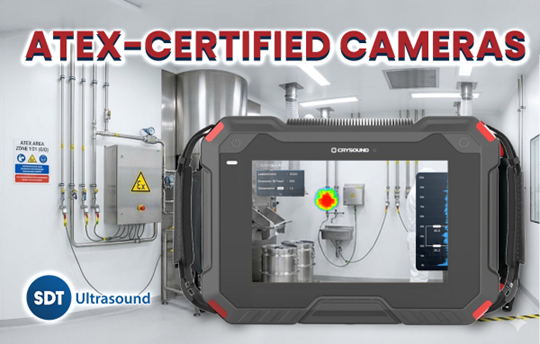
This visual feedback allows technicians to locate and document nitrogen leaks, vacuum bypasses, or electrical partial discharge from a safe distance of up to 50 meters—completely eliminating the need to enter restricted zones or interrupt active production.
Conclusion
Maintaining sterile pressure cascades and ensuring high-hazard safety requires strict operational discipline. By replacing scheduled, preventive maintenance with condition-based acoustic lubrication and remote ultrasonic imaging, pharmaceutical manufacturers can extend asset lifespans, ensure continuous cleanroom compliance, and eliminate unexpected downtime.