For pharmaceutical manufacturers, cleanrooms and ATEX-classified hazardous areas are among the most demanding environments in modern industry.
To maintain strict ISO cleanliness classifications and prevent cross-contamination, access to these controlled zones is tightly restricted. Yet the compressed air systems, process gas circuits, and electrical cabinets located within them must be monitored continuously: even a minor leak or electrical fault can compromise personnel safety, product integrity, or site energy efficiency. To address this challenge, industrial sites are turning to remote ultrasonic acoustic imaging, a technology that allows hazardous or hard-to-reach areas to be inspected without physically entering them and without interrupting production.
The Hidden Cost of Compressed Air and Gas Leaks
Compressed air and process gases, such as nitrogen, are essential utilities in pharmaceutical manufacturing. They are used for pneumatic controls, line purging, inerting, and numerous formulation processes. However, the networks that distribute them often include hundreds of fittings, valves, and connection points, each a potential source of leakage. These leaks are notoriously difficult to detect by ear, particularly in noisy production areas, on elevated piping networks, or behind hard-to-access equipment.
Left undetected, these leaks translate directly into substantial energy waste: a significant share of the compressed air produced in industry is estimated to be lost before it even reaches its point of use. They also lead to unstable process conditions, excessive strain on compressors, and unplanned maintenance interventions that disrupt production schedules.
In ATEX zones, searching for a leak by ear or through direct-contact methods is not only inefficient but may also require shutting down equipment or wearing cumbersome personal protective equipment, simply to get close enough to the suspected source.
Electrical Anomalies and Partial Discharge
Cabinets, connections, and electrical equipment operating in cleanroom and hazardous-area environments are also vulnerable to partial discharge, corona effect, and electrical tracking along insulating surfaces. These phenomena are early warning signs of insulation degradation, which can eventually lead to equipment failure, arcing, or even fire risk in an environment where the smallest spark can have serious consequences.
These electrical anomalies emit distinctive ultrasonic signatures, often well before becoming perceptible to the eye or ear of a technician standing nearby. This means that an emerging fault can, in theory, be identified weeks or even months before it worsens, provided the right tool is available and can be used from a safe distance, without needing to approach live installations.
Secure Remote Inspection Through Acoustic Imaging
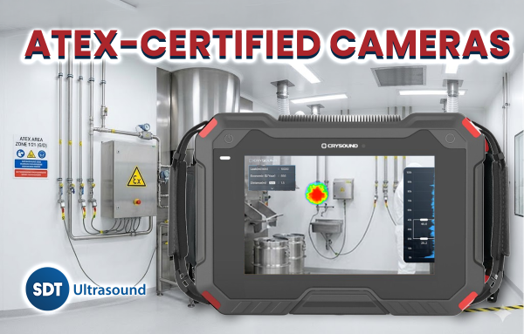
Setting up ladders, deploying aerial work platforms, or wearing heavy protective suits to inspect elevated piping or an electrical cabinet is a slow, labor-intensive operation that systematically introduces an additional contamination risk into sterile cleanrooms. With a CRYSOUND ATEX-certified acoustic camera, maintenance teams can now carry out remote, contactless inspections of both compressed air and gas installations and electrical equipment, without ever having to enter the hazardous area itself.
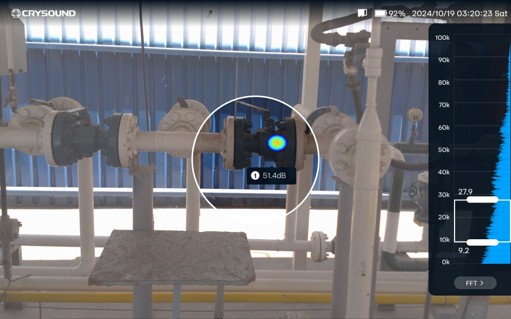
These acoustic cameras use high-performance MEMS microphone arrays to capture the ultrasonic waves emitted by leaks and electrical discharges, then convert them into a real-time color image overlaid on the optical view of the inspected area.
This immediate visual feedback, often referred to as an acoustic “bloom,” allows technicians to precisely locate and document compressed air leaks, nitrogen leaks, vacuum seal defects, or electrical partial discharges from a safe distance of up to 200 meters. This distance completely eliminates the need to enter a restricted zone, climb onto equipment, or interrupt active production to carry out an inspection.
Because these inspections are contactless and can be performed from outside the immediate danger zone, they also reduce the risk of introducing particles or cross-contamination into sterile cleanroom areas. The data collected, backed by images and acoustic recordings, can furthermore be archived and compared over time, making it possible to build a reliable history of equipment condition and to prioritize corrective actions based on the actual severity of detected anomalies, rather than on periodic visual inspection alone.
Conclusion
Ensuring energy efficiency and electrical safety in ATEX environments and cleanrooms requires visibility into problems that would otherwise remain invisible and inaudible until they become critical. By adopting remote ultrasonic acoustic imaging, pharmaceutical manufacturers can detect compressed air and gas leaks early, identify electrical anomalies well before they escalate, and protect both their personnel and their products, all without ever compromising cleanroom integrity or the inherent safety of hazardous areas.