
The most underrated failure cause in your plant
Ask a maintenance manager what breaks their machines most often, and “lubrication” rarely comes up first. And yet, it dominates the failure statistics. Many studies found that inappropriate lubrication of rolling elements causes approximately 80% of bearing breakdowns, well ahead of inadequate bearing selection (10%), improper mounting (5%), and material defects (under 1%). SKF’s own bearing failure training attributes 36% of premature bearing failures directly to lubrication, alongside fatigue (34%), mounting/handling (16%) and contamination (14%)[1]. Other reliability sources place lubrication-related causes even higher — Redlist and Reliability Solutions both cite figures of 43% of mechanical failures and up to 70% of all equipment failures traced back to improper lubrication[2]. Bearing problems specifically are estimated to account for 50–65% of all electric motor failures[3].
Whatever precise figure you pick, the pattern is the same: lubrication is the single largest controllable variable in bearing reliability. And for decades, most plants have managed it almost entirely by guesswork. Technicians grease bearings on a calendar (weekly, monthly, quarterly) regardless of actual condition, relying on their ears and instinct to decide “enough.”
The trap: over-lubrication is just as dangerous as under-lubrication
Here’s the counterintuitive part. Industry commentary consistently flags over-lubrication, not just under-greasing, as a leading cause of premature bearing failure once time-based routines are in place[4]. Too little grease allows metal-to-metal contact and abrasive wear. Too much grease raises internal pressure and churning friction, drives up operating temperature, and can blow past seals, degrading the lubricant and, eventually, the bearing itself. Both failure modes are real, and time-based greasing schedules protect against neither, because they aren’t measuring anything. They’re just following a calendar.
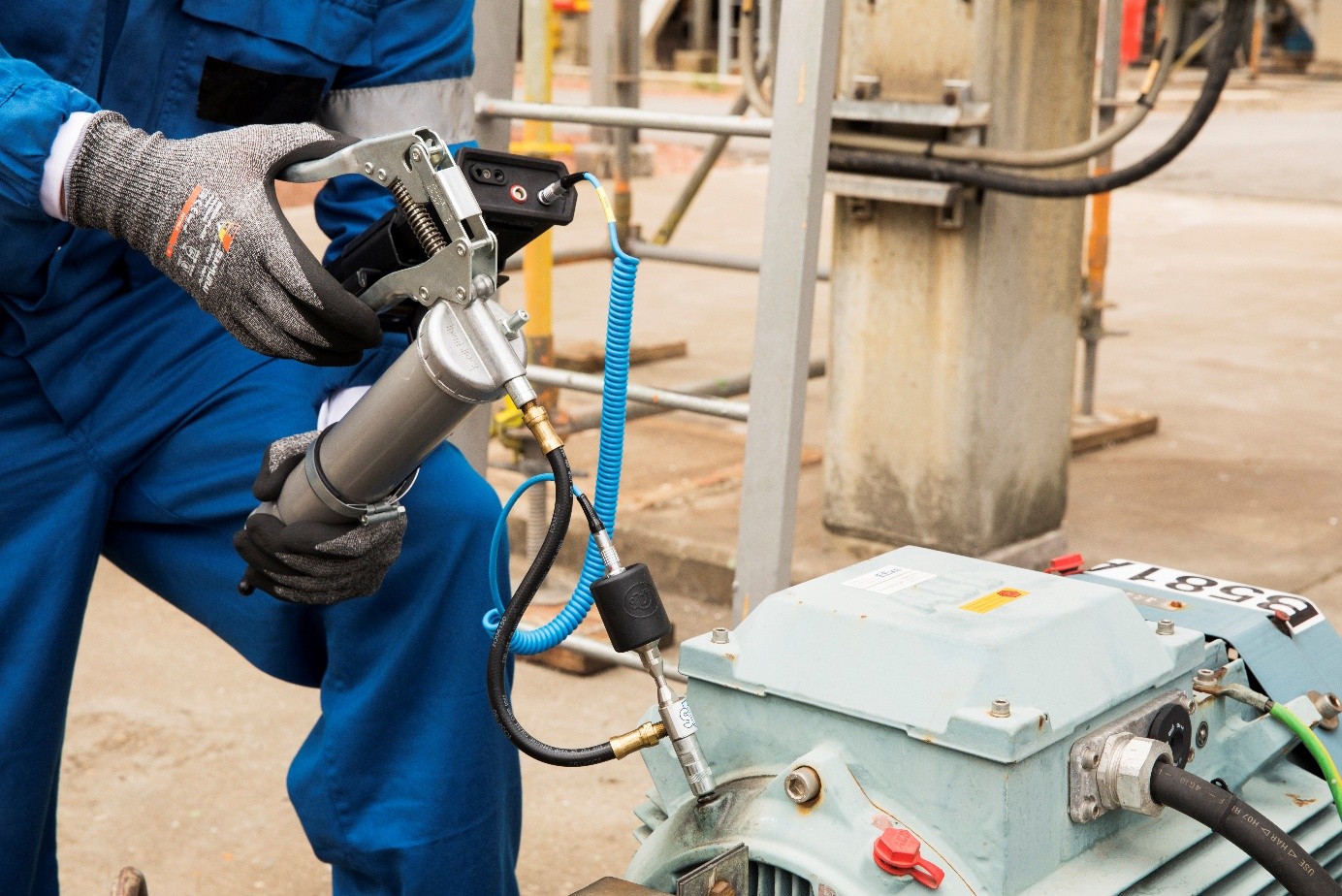
The physics: bearings tell you exactly what they need — if you listen correctly
Every bearing in operation emits ultrasonic energy (high-frequency sound in the 20 kHz–100 kHz range, well above human hearing) generated directly by friction, impact, and turbulence at the rolling-element contact zones. As grease film thickness changes, so does that ultrasonic signature. An under-greased bearing sounds loud and harsh in the ultrasonic spectrum because metal asperities are making direct contact. A properly lubricated bearing runs quiet, because the elastohydrodynamic film cushions those contacts. Add too much grease, and friction rises again, because the rolling elements now have to churn through excess material.
That U-shaped relationship between grease quantity and friction is the foundation of acoustic lubrication technology. Ultrasound doesn’t just tell you a bearing is “loud” or “quiet”, it lets a technician, or a machine, find the minimum point on that curve in real time, stopping the grease gun the instant friction (and therefore energy loss, heat, and wear) is minimized. As SDT Ultrasound puts it in its own technical literature: “Ultrasound can detect increased levels of friction as a result of too much, or too little grease… Only comparative analysis of the status of the bearing, before and after greasing, is truly objective”.
Why “just listening” isn’t enough
It’s tempting to think a trained ear and a stethoscope-style ultrasound listening device is sufficient. It isn’t. As reliability specialists note: “Using audible feedback alone is not enough to make a comparative conclusion. Every person hears things differently, and it’s impossible to remember what the bearing sounded like a month ago”[5]. Objective, quantified, repeatable decibel measurement (not subjective listening) is what turns ultrasound from an interesting curiosity into a genuine precision maintenance tool. This is exactly the gap that purpose-built instruments like SDT’s LUBEChecker, SDT340 LUBExpert Mode, and LUBExpert ON-GUARD are designed to close.
Why this is bigger than “just grease”
It’s easy to file bearing grease under minor housekeeping. The numbers say otherwise. A landmark peer-reviewed study by Holmberg and Erdemir, published in the journal Friction[6], calculated that approximately 23% (119 exajoules) of the world’s total energy consumption originates from tribological contacts (friction and wear) of which about 20% (103 EJ) is lost directly overcoming friction, and 3% (16 EJ) is spent remanufacturing worn parts and equipment after wear-related failure[7]. Bearings sit at the center of that friction budget, because they are the mechanical interface inside nearly every motor-driven system in a plant, and motor-driven systems account for more than 40% of global electricity consumption, rising to roughly 69–72% of industrial electricity use specifically, according to the International Energy Agency[8].
In other words, precision lubrication isn’t a housekeeping task. It’s an energy-efficiency intervention with the same underlying economics as high-efficiency motors or variable-speed drives, and it starts with something as simple as knowing, objectively, when to stop pumping the grease gun.
[1] ReliaMag, “Bearing Failure Cause Statistics,” 2026)[2] Redlist, 2024; Reliability Solutions, 2026[3] Reliability Solutions, “Over-Lubrication in Bearings,” 2026[4] Bearing News / Maintenance and Engineering, 2019–2020[5] Redlist, “Greased Bearing Failure: Lubrication Mistakes to Avoid,” 2024[6] Springer/Tsinghua University Press, 2017[7] Holmberg & Erdemir, Friction, 5(3), 263–284, 2017[8] IEA, “Energy-Efficiency Policy Opportunities for Electric Motor-Driven Systems,” 2011; IEA-4E EMSA Policy Brief, 2026