
The energy and sustainability case for precision lubrication is compelling on its own. But two other business drivers matter just as much on a plant floor: how much unplanned downtime costs, and whether new tools help (or threaten) the people doing the work. On both counts, the case for ultrasound-guided lubrication, as built by the LUBEChecker, the SDT340 LUBExpert Mode, and the LUBExpert ON-GUARD, is unusually strong.
Unplanned downtime: the most expensive line item most plants underestimate
Siemens’ 2024 “True Cost of Downtime” study, conducted with Senseye, found that Fortune Global 500 industrial companies collectively lose approximately $1.4 trillion per year to unplanned downtime (around 11% of total revenue) up 62% from the $864 billion recorded just three years earlier, in 2021[1]. The average large plant now loses roughly 360 production hours annually to breakdowns, and 82% of companies report experiencing at least one unplanned downtime event in the past three years. In the United States alone, unplanned downtime is estimated to cost industrial manufacturers close to $50 billion a year, with the average manufacturing plant losing between 5% and 20% of its annual productivity to downtime[2].
Where does that downtime come from? Bearing wear, seal failure, shaft imbalance, and misalignment together account for the single largest share of unplanned stoppages across manufacturing sectors[3], and, the majority of that bearing wear traces directly back to how (and whether) it was greased correctly.
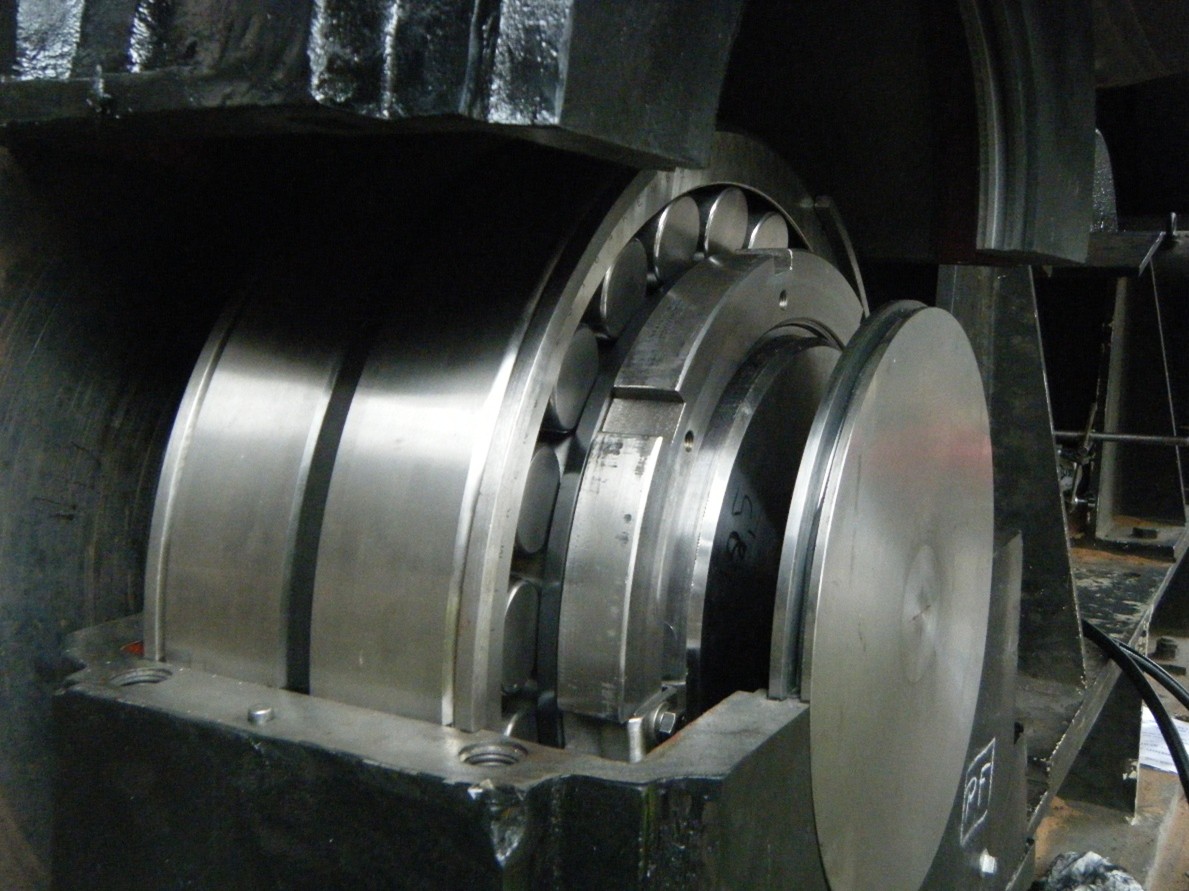
Put plainly: a grease gun and a few minutes of a technician’s time, guided by real acoustic data instead of a wall calendar, is one of the cheapest interventions available against one of the most expensive line items in industrial reliability.
The efficiency dividend: less wasted labor, not just fewer failures
Beyond avoided downtime, precision lubrication pays off in freed-up time for the people running the program. One of our documented case studies on a slow-speed ball mill bearing (1,600 mm outer diameter, 18.6 RPM) shows this concretely: after implementing LUBExpert-guided, condition-based lubrication, a plant was able to triple the interval between condition-monitoring data collection runs, because grease replenishment was now happening on a genuinely condition-justified 14-day cycle rather than an arbitrary calendar, while detectability of developing faults did not decrease. The specialist hours freed up were redirected to expanding asset coverage and deeper analysis elsewhere in the plant. That’s a measurable productivity gain, not a marketing claim.
The SDT340 LUBExpert Mode specifically targets a structural inefficiency common to most reliability programs: condition monitoring and lubrication are usually run by different people, on different schedules, with different records, even though they act on the exact same bearings. By loading guided lubrication work orders directly onto the same device used for vibration and ultrasound route data, and tying every grease shot, grease type, and friction reading to the asset’s condition history in one database, SDT closes that loop. To put it plainly, machinery lubrication remains the single biggest factor affecting asset reliability, and yet so many still get it wrong. This brings precision, guidance, and consistent documentation to this routine maintenance task, in one connected workflow.
Workforce empowerment: tools designed to elevate people, not replace them
There’s a natural fear in any maintenance organization that “smart” tools and automation exist to replace people. SDT’s positioning clearly goes in the opposite direction, and the product architecture backs it up.
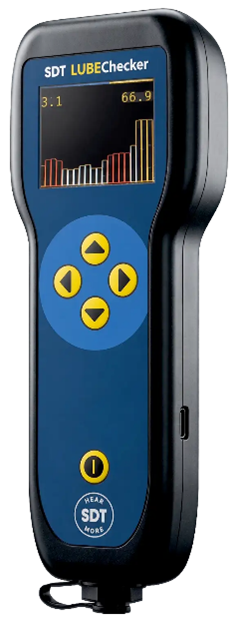
LUBEChecker: putting expert-level judgment into every operator’s hands.
Instead of restricting precision lubrication skills to a small, specialized reliability team, a simple, rugged, objective instrument lets any trained operator perform condition-based greasing correctly during their normal daily rounds. Operator-Driven Lubrication (ODL) is a key part of SDT’s Operator-Driven Safety and Reliability (ODSR) approach. It gives front-line operators the tools and confidence to maintain bearing health during their daily rounds. When operators take ownership of lubrication, maintenance becomes proactive, not reactive. This matters enormously against the backdrop of a well-documented skilled-labor shortage in industrial maintenance: rather than requiring years of tribology training to “listen” for the right sound, the LUBEChecker converts institutional expertise into an objective decibel reading anyone can act on consistently, shift after shift.
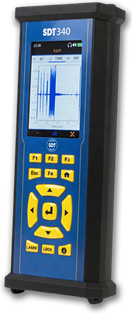
SDT340 LUBExpert Mode: elevating technicians, not de-skilling the job.
For dedicated reliability and lubrication technicians, the SDT340 LUBExpert Mode does the opposite of simplifying the job away. It gives technicians access to laboratory-grade diagnostic data (high-resolution ultrasound, vibration, and tachometer readings, all in one device) that used to require multiple separate instruments and specialized interpretation. Guided work orders reduce the risk of human error or missed steps, while the underlying data (full time-waveform recordings, condition indicators, trend history) remains available for a technician or engineer to dig into for deeper analysis when something looks unusual. It turns a routine grease-gun task into a documented diagnostic event, raising the skill ceiling and professional value of the role.
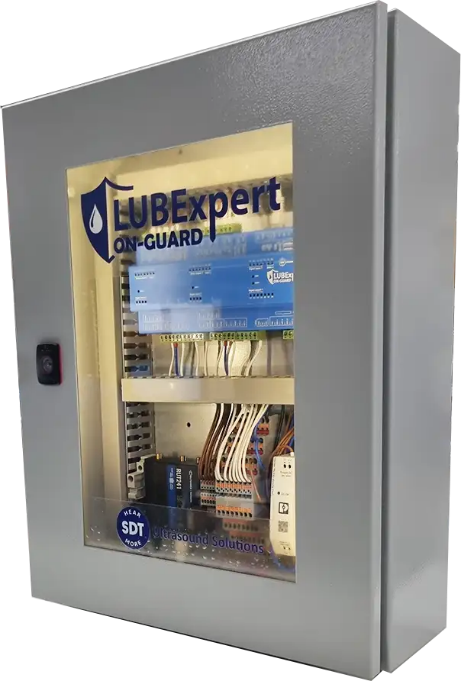
LUBExpert ON-GUARD: automation aimed at the worst jobs, not the whole job.
It’s automation is deliberately targeted at the assets where manual lubrication is hardest, riskiest, or most easily missed (elevated, hard-to-access, or hazardous-environment bearings) freeing technicians from repetitive, sometimes unsafe routes so they can spend their expertise on diagnosis, root-cause analysis, and the more complex assets that genuinely need a trained human.
Taken together, the three tools map onto a workforce strategy as much as a technology strategy: broaden precision-lubrication capability to every operator (LUBEChecker), deepen the diagnostic capability of specialist technicians (SDT340 LUBExpert Mode), and remove people entirely from the highest-risk, lowest-value manual tasks (LUBExpert ON-GUARD), while keeping humans firmly in charge of the decisions that require experience and judgment.
Our final take
One small maintenance habit (how a bearing is greased) turns out to touch nearly every priority on a modern industrial agenda:
- Reliability: lubrication drives an estimated 36–80% of bearing failures depending on the study, and bearing issues cause 50–65% of motor failures[4].
- Downtime economics: unplanned downtime costs Fortune Global 500 manufacturers roughly $1.4 trillion a year — 11% of revenue[5].
- Energy: motor-driven systems consume 69–72% of industrial electricity[6], and friction accounts for roughly 20% of the world’s total energy use[7] — bearing friction management is a direct efficiency lever.
- Regulatory compliance: Directive (EU) 2023/1791’s binding audit and EMS obligations, phased in through October 2026 and October 2027, reward exactly the kind of granular, evidence-based lubrication logging these tools generate automatically.
- Workforce: from the LUBEChecker’s operator-driven simplicity to the SDT340’s diagnostic depth to the LUBExpert ON-GUARD’s targeted automation, the technology is explicitly designed to raise the capability of the people doing the work, not replace them.
For a task most plants still treat as a five-minute afterthought on a route sheet, that is a remarkable return, and one that a plant manager, a sustainability officer, and a compliance auditor can each verify independently.
[1] Osorno Group, citing Siemens/Senseye, 2024/2026[2] Manufacturing Downtime Cost Statistics, 2026[3] iFactory, “Unplanned Downtime Costs $253B Annually,” 2026[4] SKF training data via ReliaMag, 2026; Bearing News, 2020; Reliability Solutions, 2026[5] Siemens/Senseye, 2024[6] IEA-4E, 2026[7] Holmberg & Erdemir, 2017