The global food and beverage sector is currently traversing a period of unprecedented structural transformation, defined by a confluence of macroeconomic headwinds, regulatory shifts, and technological disruptions.
As the industry moves toward the second half of the decade, the traditional ways of industrial management, which were largely governed by a “growth-at-all-costs” mentality, have been rendered obsolete by a “pincer movement” of economic pressures. On one side of this strategic divide, manufacturers are grappling with the extreme volatility of raw material costs and a profound energy crisis that has reshaped the cost of quality and food safety.
On the opposing side, a fundamental shift in consumer behavior and regulatory oversight is demanding a level of environmental transparency and carbon accountability that was previously reserved for discretionary corporate social responsibility initiatives.
In this climate, even a minor erosion of margin (as little as 2%) can jeopardize the long-term stability of a food processing enterprise. The “Industrial RESET,” a strategic framework emerging for 2026, demands that maintenance no longer be treated as a “necessary evil” or a reactive cost center, but rather as a “Profit Protector”. By utilizing ultrasonic data to make the invisible visible, organizations can reclaim the capacity lost to the “Hidden Factory”—the portion of a plant’s capacity that is effectively wasted due to substandard quality, unplanned equipment downtime, and pervasive energy inefficiencies.
I. The Invisible Drain: Energy and Sustainability
The ongoing energy crisis has moved beyond a simple increase in utility bills to become an integral component of the “cost of quality” in food manufacturing. Energy is essential to every stage of the production process, from growing and harvesting to processing, packaging, and refrigeration. Any increase in energy costs directly inflates the overall production cost, but the indirect effects are often more insidious. For example, maintaining precise parameters for temperature and humidity is critical for food safety; however, the rising cost of energy has made it increasingly difficult for facilities to guarantee these parameters.
This difficulty often leads to “overprocessing” through thermal technologies. Food and beverage companies may suffer financial losses due to excessive heat treatment, which not only increases energy consumption but also degrades the quality of the final product. Overprocessing can lead to changes in taste, texture, and nutritional value, which in turn reduces customer loyalty and can even result in product rework or recalls. Consequently, manufacturers are urgently investing in energy-efficient equipment and digital solutions that provide insights into energy consumption patterns and help identify sources of waste.
Sustainability has moved from the peripheral PR department to the center of the boardroom. For food and beverage giants, the race to Net-Zero is no longer a voluntary journey but a regulatory mandate, driven by the European Corporate Sustainability Reporting Directive (CSRD) and a global shift toward carbon taxation. In this new landscape, the carbon footprint of a liter of beverage or a kilogram of flour is a Key Performance Indicator (KPI) as critical as yield or throughput.
Agriculture and food production currently account for nearly one-third of global carbon emissions. This has led to a shifted focus from traditional production methods toward investments in renewable projects and the adoption of regenerative practices. However, the high upfront costs of transitioning to sustainable methods and the potential for short-term yield variability remain significant barriers. Digital platforms that collect Environmental, Social, and Governance (ESG) data are becoming essential tools for companies to manage these transitions and comply with increasingly complex regulations.
Persistent inflation has fundamentally altered consumer spending patterns, with 92% of consumers reporting reduced spending on even essential goods like groceries. As wage increases have not kept pace with cost inflation, real disposable incomes have declined, leading to elastic demand and making it difficult for manufacturers to pass cost increases on to the consumer. This environment requires manufacturers to find internal efficiencies to keep products affordable.
Simultaneously, the industry faces a critical workforce shortage, particularly in technical roles. While the percentage of companies experiencing staffing shortages has declined since the post-pandemic peak, 57% of executives remain moderately or highly concerned about maintaining workforce levels. To combat this, businesses are turning toward automation and technology to reduce dependency on manual labor. Those companies that have successfully integrated automation into their supply chains and production lines were significantly more likely to report profit growth in 2024 than their counterparts who remained reliant on manual processes.
The compressed air crisis
Compressed air is often called the “fourth utility,” yet it is frequently managed with zero rigor. It is estimated that 30% of all compressed air generated in a typical industrial facility is lost to leaks.
- Financial impact: In a large bottling plant, a single 3mm leak in a washdown line is a direct conversion of electrical currency into turbulent noise, with annual wasted expenditures often exceeding 150,000€.
- Environmental impact: A tiny 1/16-inch air leak wastes energy equivalent to 4 tonnes of CO2 emissions annually.
Thermodynamic efficiency in steam systems
Steam is essential for cooking, pasteurizing, and sterilizing, yet steam trap failures are a primary driver of thermal energy loss.
- Failed-open traps: A single trap stuck “open” can waste more than 22.5 kg of steam per hour, leading to hundreds of tons of unnecessary CO2 emissions every year.
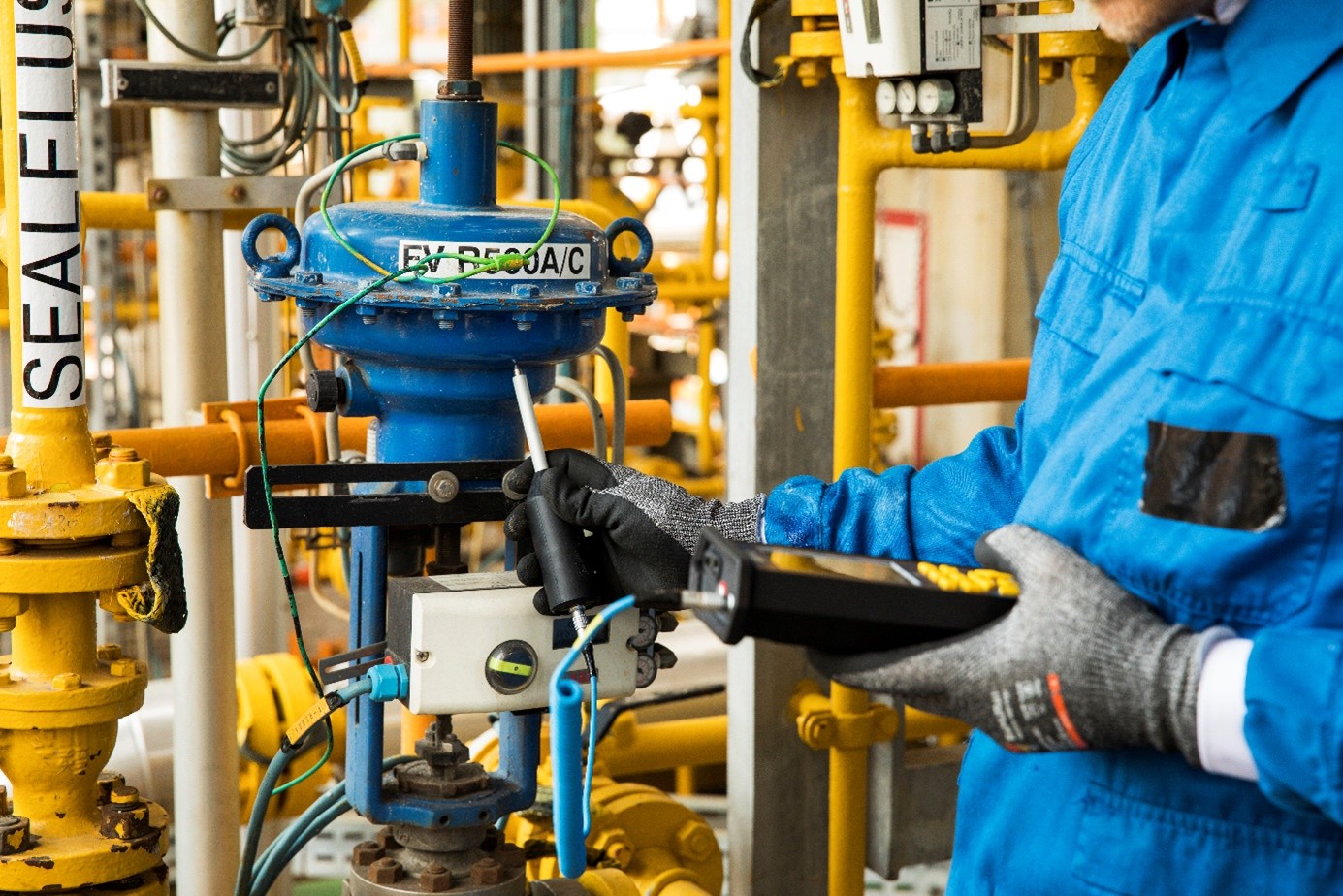
- The ultrasound solution: Tools like the TRAPChecker allow technicians to “hear” the internal cycles of a trap, distinguishing between a healthy valve snap and the continuous roar of a blow-through condition.
II. Strengthening Asset Reliability and Uptime
In the F&B sector, the cost of equipment failure is non-linear. If a bearing fails on a critical conveyor in a dairy plant, the cost includes not just the replacement part, but thousands of gallons of scrapped product and the high cost of re-sanitizing the entire line.
Moving beyond “firefighting”
Predictive maintenance using ultrasound provides the “first line of defense”. It detects microscopic stress waves caused by subsurface fatigue long before heat or vibration manifest.
- Case study (ADM Razgrad): At the ADM Razgrad food processing facility in Bulgaria, a strategic predictive maintenance program centered on ultrasound allowed the team to identify defects months in advance, reclaiming capacity lost to unplanned downtime.
Precision lubrication: The foundation of resilience
Up to 80% of premature bearing failures are attributed to poor lubrication practices. Traditional calendar-based greasing leads to over-lubrication (causing friction and seal damage) or under-lubrication (causing wear).
- The SDT340 solution: SDT’s SDT340 in LUBExpert mode uses “guided mode” to tell technicians exactly when to grease and when to stop based on real-time friction calculations.
Resource optimization: By integrating grease technicians into the reliability team (a strategy known as the “Pick and Roll”) specialists can triple their data collection frequency without increasing manpower.
III. The SDT Ultrasound Ecosystem
SDT provides a comprehensive suite of tools designed to bridge the gap between the production floor and the boardroom.
| Solution | Application | Impact |
|---|---|---|
| SDT340 | Advanced Diagnostics | Combines ultrasound, vibration, and temperature for a “total picture” of asset health. |
| CRYSOUND Cameras | Acoustic Imaging | Visualizes energy waste as a “sonic cloud” on a screen, making decarbonization tangible. |
| Vigilant | Permanent Monitoring | Provides 24/7 oversight for critical or hard-to-access assets. |
| CHECKER Range | Targeted Troubleshooting | Low-cost, task-specific units for air leaks, steam traps, and lubrication. |
IV. Return on Investment (ROI)
Ultrasound technology is one of the few industrial investments that can pay for itself on “day one”.
- Utility savings: Reducing air loss leads directly to lower electricity bills.
- CAPEX deferral: By optimizing existing compressors, facilities can delay the purchase of expensive new units.
- Total cost of ownership: Shifting to root-cause elimination (precision lubrication) results in fewer total failures and lower long-term repair costs.
Conclusion: Hearing the Future
The food and beverage industry of 2025 is navigating a landscape defined by extreme economic volatility and an urgent mandate for environmental stewardship. In this environment, the “Hidden Factory” can no longer be ignored. Ultrasound technology, as delivered through SDT Ultrasound’s comprehensive ecosystem of solutions, provides the strategic bridge required to link the physics of the production floor with the financial intelligence of the boardroom.
By focusing on thermodynamic efficiency through the elimination of compressed air and steam leaks, organizations can achieve rapid CO2 emission reductions and meet their Net-Zero targets. By shifting from reactive “firefighting” to proactive, condition-based maintenance and precision lubrication, facilities can dramatically boost uptime and strengthen asset reliability. The integration of permanent monitoring and Industry 4.0 connectivity ensures that these reliability gains are sustainable, even in the face of persistent labor shortages.
Ultimately, the implementation of ultrasound is not merely a technical upgrade; it is a fundamental shift toward an “Industrial RESET.” It is the process of making the invisible audible, turning the sounds of waste into the data of success. For the food and beverage industry, hearing the future through ultrasound is the only viable path to a shippable, profitable, and sustainable product in an increasingly complex global market.